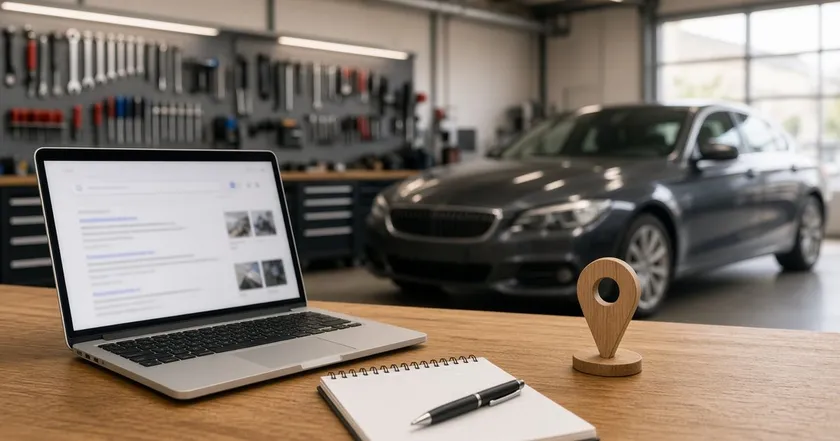
This isn't a made-up marketing parable. It's what happened to me recently with my own car — and it's stuck with me because of what it says about businesses that still don't have a website or a Google Business Profile.
I'm Nathan Constance. I run NC Digital from Merthyr Tydfil, building WordPress websites for small businesses across Cardiff and South Wales. Most days I'm the one telling people they need to show up online. This time I was just a customer with a problem to solve.
The car needed a proper gearbox service
My car needed a specific gearbox service for a Mercedes. Not a quick oil top-up — the kind of job that needs the right kit and someone who actually knows that gearbox.
I took it to my usual garage first. They were honest with me. They didn't offer that service because it needed a specific tool they didn't have. Fair enough. No hard feelings. But it left me needing to find a garage that did.
So I did what a lot of people do. I started asking around.
First stop: Facebook recommendations
I posted on Facebook asking if anyone could recommend a garage that does this kind of gearbox work. People were helpful. I got a few recommendations.
Then I did the next obvious thing. I grabbed those company names and put them into Google.
That's where it fell apart for those businesses.
Those garages didn't have websites. No site to check. No easy way to see what they offered or get in touch properly.
So I cast them aside.
That sounds harsh when I write it down. Those garages might do excellent work. Someone on Facebook trusted them enough to recommend them. But from my side of the screen, with a Mercedes gearbox job hanging over me, I wasn't going to chase a name with no website. I moved on.
If you've ever wondered why your small business needs a website, not just social media, that's the short version in real life. A Facebook mention got them into the conversation. The missing website knocked them back out.
Then I asked ChatGPT
Next I tried ChatGPT with the same query — needing a specific gearbox service for a Mercedes and wanting a garage that could actually do it.
ChatGPT came back with four or five companies.
Every one of them had a website. Every one had a Google Business Profile. They ranked well enough that I could find them properly. And they had quite a few reviews — five-star or four-star stuff, not empty listings with nothing behind them.
That was enough for me to take them seriously.
I went onto one of those recommended garages' websites, got in touch, and booked the work. I ended up spending £870 with that garage.
Not because a mate whispered the name in my ear. Because they had a website I could check, a Google Business Profile with reviews I could read, and because they got cited when I asked ChatGPT for help.
What that £870 job really bought
From the garage's point of view, that job wasn't "SEO theory". It was nearly nine hundred pounds of work that arrived because they were findable when I was ready to spend.
From my point of view as a customer, the path was simple:
- Facebook gave me names without proof.
- No website meant those names got dropped.
- ChatGPT pointed me at businesses that looked real online.
- Website + Google reviews made one of them easy to contact and trust.
- The job got booked.
That's the bit I keep thinking about for the businesses I work with in Cardiff, Merthyr and the rest of South Wales. People still ask friends. They still post in groups. But a growing number also ask tools like ChatGPT — and those tools lean hard on what they can see: sites, listings, reviews, clear service information.
If you're invisible there, you don't just miss Google. You miss the recommendation layer on top of Google too.
The moral (and it's not complicated)
If you don't have a website or a Google Business Profile, you could be missing out on work.
That's it. No fancy funnel diagram required.
Facebook recommendations helped a few garages get mentioned. Without a site, they never made my shortlist. The places ChatGPT suggested all had the basics covered — a website, a Google Business Profile, decent reviews, and enough visibility that they looked like a safe bet for a specialist job.
You don't need a huge site. You need something clear: who you are, what you do, how to get in touch, and a Google profile that matches. If your Google listing is thin or unfinished, how to optimise your Google Business Profile is a practical place to start. If the website itself is the gap, local web design in Cardiff or web design in Merthyr Tydfil is the work I do every week for trades and service businesses that want enquiries, not just a Facebook page.
I see the same pattern from the other side of the desk. Someone gets recommended. They Google the name. No site. They move on. Or they ask an AI tool and only the businesses with a proper online footprint come back. The job goes elsewhere — sometimes for hundreds of pounds, sometimes for thousands.
My gearbox bill was £870. That garage earned it because they were easy to find, easy to check, and easy to contact when I was ready.
A quick offer if your site's the weak link
Through November I'm running a free 20-minute website check-up for South Wales businesses. Ten places. You email info@nc-digital.co.uk with your website address and put Website check-up in the subject. I'll tell you what's helping, what's quietly losing you trust, and what I'd fix first — including the kind of gaps that make people (and ChatGPT) skip past you.
Full details are on the contact page. Offer runs 2–30 November 2026.
I didn't write this as a scare story. I wrote it because I lived it as a customer, then looked at it again as someone who builds sites for a living. The businesses that got recommended on Facebook but had nothing to show online never got a look in. The ones with a website, a Google Business Profile and real reviews did — and one of them got the £870 job.
Don't be the recommendation that gets cast aside.